Regain Comfort in Your Legs with Attentive Care
Phlebology
With two vascular surgeons on our team, our clinic offers specialized expertise in the assessment and treatment of venous and vascular conditions.
We provide professional, compassionate care to deliver the most suitable solutions for your situation.

- What Are Varicose Veins?
Understanding Varicose Veins
Varicose veins are dilated, visible superficial veins, most commonly located in the legs. Contrary to popular belief, these are not obstructed veins, but rather veins where blood circulation is less efficient.
Normally, blood flows from the feet toward the heart through a system of venous valves that close to prevent blood from flowing back down into the legs. Muscle contractions, particularly in the calves, also help pump blood upward. When these valves no longer function properly, blood can flow backward and pool in the veins, causing them to dilate.
Varicose veins are part of chronic venous insufficiency, a common condition that can progress over time. Several factors can contribute to their development, including genetics, pregnancy, hormonal changes, prolonged standing, obesity, and heat.
They can cause heavy legs, discomfort, swelling, or pain. In some cases, they may also lead to skin changes, superficial phlebitis, or venous ulcers.
A phlebology consultation and a venous ultrasound allow for a thorough evaluation of your condition, identification of the affected veins, and determination of the most appropriate treatment.
-
Family history
-
Pregnancy
-
Age
-
Being overweight
-
Hormonal changes
-
Prolonged standing or sitting
Beyond their aesthetic appearance, varicose veins and venous insufficiency can also cause various discomforts, including:
-
Cramps
-
Leg fatigue
-
Pain or discomfort
-
Itching
-
A feeling of heaviness in the legs
-
Swelling of the legs or ankles
Consultation and Assessment
Each consultation begins with a thorough assessment of your condition to better understand your symptoms and needs. Through a careful evaluation and a personalized approach, we guide you toward the solutions best suited to your venous health.
-
Comprehensive Assessment
During your first visit, we take the time to understand your situation, symptoms, and concerns in order to provide personalized care and a thorough clinical assessment.
-
Ultrasound
An ultrasound is performed on-site while you are standing to assess your venous circulation and provide an accurate diagnosis.
-
Treatment Plan
Following the assessment, a treatment plan tailored to your needs is proposed, taking into account your condition and goals.
-
Measurements and Clinical Photographs
Targeted measurements and clinical photographs are taken during the consultation to document your baseline condition, monitor progress, and adjust your care plan as needed.
Varicose Vein Treatments
Sclerotherapy
Visual sclerotherapy is an injectable treatment used to treat small varicose veins, medium-sized veins, and visible spider veins. The injected solution acts directly on the vein wall to gradually close the vein. Blood is then naturally redirected to healthy veins.
Treatment is generally performed over several sessions of approximately 15 minutes. Each treatment plan is personalized according to the extent of the varicose veins and the patient’s goals.
A minimally invasive treatment performed in clinic, allowing for a quick return to daily activities.
Ultrasound-Guided Foam Sclerotherapy
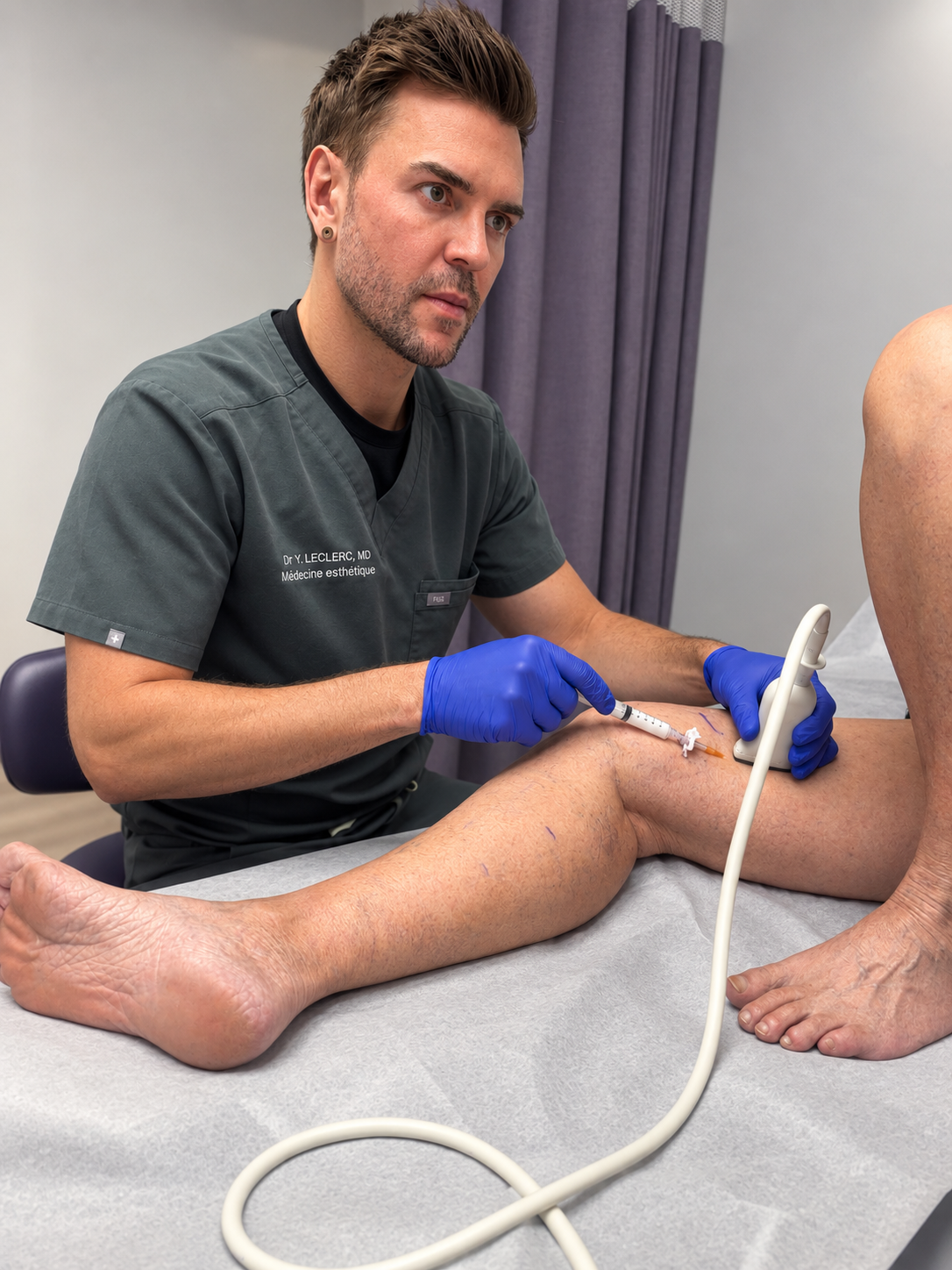
This technique uses a sclerosing foam made by mixing a medication with air. The foam allows more uniform contact with the vein wall and can improve treatment effectiveness.
Guided by ultrasound, this approach allows certain larger or more dilated varicose veins to be treated precisely, particularly when reflux is present in the deeper veins. It is performed by a phlebology physician or a vascular surgeon, ensuring safe and personalized care for each patient.
This technique is particularly indicated for small to medium-sized varicose veins.
Endovenous Laser Treatment
Endovenous laser treatment is a modern technique used to treat certain incompetent veins without traditional surgery. Using a thin laser fiber inserted into the vein, thermal energy causes the diseased vein to close, after which it is gradually reabsorbed by the body.
This procedure is performed by a vascular surgeon and is a well-established treatment option for the saphenous veins responsible for many cases of varicose veins.
A modern option for treating certain veins without traditional surgery.
MOCA (Mechanochemical Ablation)
MOCA is a minimally invasive technique used to treat certain varicose veins without heat or surgery. Using a specialized catheter, the inner wall of the vein is mechanically treated while a sclerosing agent is injected simultaneously.
This approach effectively closes the treated vein while providing excellent comfort during the procedure.
The treatment is performed by a vascular surgeon directly in the clinic and allows for a quick return to normal activities.
Medical Adhesive
Medical adhesive, particularly the VenaSeal system, is one of the modern treatments available for venous insufficiency. It allows the vein to be sealed without the use of thermal energy.
This technique is selected based on the venous anatomy and the specific needs of each patient following an assessment and ultrasound examination.
This approach is performed by a vascular surgeon and may be recommended based on the diagnosis.
Microphlebectomy
Microphlebectomy is a procedure used to remove certain visible varicose veins through very small incisions made on the surface of the skin. This technique allows larger veins that cannot be effectively treated with injections alone to be removed directly.
Depending on the patient’s condition, complementary treatments such as sclerotherapy may be recommended after the procedure to optimize results. Regular follow-up also helps monitor long-term venous health.
The procedure is performed meticulously by a vascular surgeon to promote a comfortable recovery.
Minor Procedures
Certain complementary procedures may be recommended depending on your venous condition and the results of your assessment. These procedures are performed in a safe environment and are intended to improve your comfort and support your venous health.
They may include the treatment of skin lesions such as sebaceous cysts, lipomas, nevi, skin tags, ingrown toenails, or other types of skin lesions.
Treatment options will be discussed with you to determine the approach best suited to your needs and goals.
These procedures are performed by a physician or a vascular surgeon in a safe environment and are intended to improve your comfort and support your venous health.
Screening and Diagnosis of Peripheral Arterial Disease
Screening and diagnostic testing for peripheral arterial disease can be performed to provide a comprehensive assessment of your arterial circulation. This evaluation helps detect potential narrowing or blockages in the arteries that may affect blood flow to the organs and limbs.
When necessary, a Doppler ultrasound examination of the carotid arteries, abdominal aorta, and arteries of the lower limbs may be performed. This non-invasive examination allows blood flow to be analyzed in real time and helps accurately identify any abnormalities in arterial circulation.
This approach allows for an accurate diagnosis and appropriate care based on the results.
Take the first step toward lighter-feeling legs.
- Treatments and Care
Custom-Fitted Compression Stockings
Compression stockings are an essential part of managing venous conditions. They apply graduated pressure to the legs, promoting blood flow back toward the heart, improving circulation, and helping reduce symptoms such as heaviness, swelling, and leg fatigue.
They may also help slow the progression of venous insufficiency when used regularly and appropriately.
Our team takes precise measurements to ensure an optimal fit, maximum comfort, and appropriate therapeutic effectiveness.
Prescription
You may come in with an existing prescription. If necessary, an assessment can also be performed on-site to provide you with a prescription tailored to your condition.
Process
The process includes an assessment of your needs, measurements, ordering of the stockings, and fitting.
Our team also provides guidance on how to wear and care for your compression stockings properly.
Our Custom-Fitted Compression Stocking Service
Since every person has different needs, our team will guide you in choosing the appropriate model and compression level.
Precise measurements are taken on-site to ensure an optimal fit, maximum comfort, and therapeutic effectiveness suited to your condition.
Why Wear Compression Stockings?
Compression stockings may be recommended for:
- Varicose veins
- Heavy or tired legs
- Leg swelling
- Prevention of venous insufficiency
- Follow-up care after certain varicose vein treatments
- Certain situations during pregnancy
FAQ
Are Varicose Veins Obstructed Veins?
Why Do Varicose Veins Develop?
The exact cause of varicose veins is multifactorial and is not yet fully understood. However, several factors are recognized as contributing to their development or accelerating their progression, including pregnancy, hormonal changes, obesity, exposure to heat, and occupations involving prolonged standing.
Genetics also plays a major role in the development of venous disease. The risk of developing varicose veins is estimated at approximately 50% when one parent is affected and can reach nearly 80% when both parents are affected.
Chronic venous disease is common in the general population. It is more prevalent among women than men and affects approximately 30 to 40% of adults. An estimated 25% of women develop symptoms during their lifetime, making it an important public health concern.
Can Varicose Veins Go Away on Their Own?
No. Varicose veins are associated with chronic, progressive venous disease and generally do not disappear on their own. Treatments can help manage existing varicose veins and control the progression of the condition.
Given its progressive nature, regular clinical monitoring is recommended, as the gradual deterioration of venous disease is estimated at approximately 5% per year. Appropriate follow-up can help limit disease progression and prevent complications.
How Many Sclerotherapy Sessions Are Needed?
Every situation is different. The number of sessions depends on the extent and size of the varicose veins, as well as the individual response to treatment. During your consultation, the physician can provide an estimate of the number of sessions needed to achieve realistic results.
Are Varicose Vein Treatments Painful?
Most treatments are well tolerated. Some people may experience mild discomfort during injections or in the days following treatment. Your care team will explain what to expect and the measures you can take to promote your comfort.
When Will I See Results?
Improvements in symptoms, such as leg heaviness or discomfort, may be noticed early in the treatment process. Aesthetic results generally appear gradually over the weeks and months following treatment.
Can I Receive Varicose Vein Treatments During Pregnancy?
Varicose vein treatments are generally postponed during pregnancy and breastfeeding. An assessment can nevertheless be performed to provide guidance on appropriate measures to take during this period.
Can Varicose Veins Be Prevented or Kept From Worsening?
Certain habits can help improve circulation and slow the progression of venous disease, including regular physical activity, maintaining a healthy weight, wearing compression stockings when recommended, and avoiding prolonged periods of inactivity.
Can I Travel Before or After Varicose Vein Treatment?
Travel or trips lasting 6 hours or more (or totaling 6 hours or more in the same day) are not recommended during the 2 weeks before and after a venous treatment, in order to ensure safe care.
Should I Inform the Clinic About Recent Surgery or Changes in My Health?
Yes. Any surgery or new medical condition that has occurred within the 12 months prior to your appointment should be disclosed during your consultation. This also includes any cortisone injections, new medications, antibiotic use, or ongoing medical investigations.
Stay Informed
Take Care of Your Leg Health
Our team is here to support you with solutions tailored to your condition and needs.